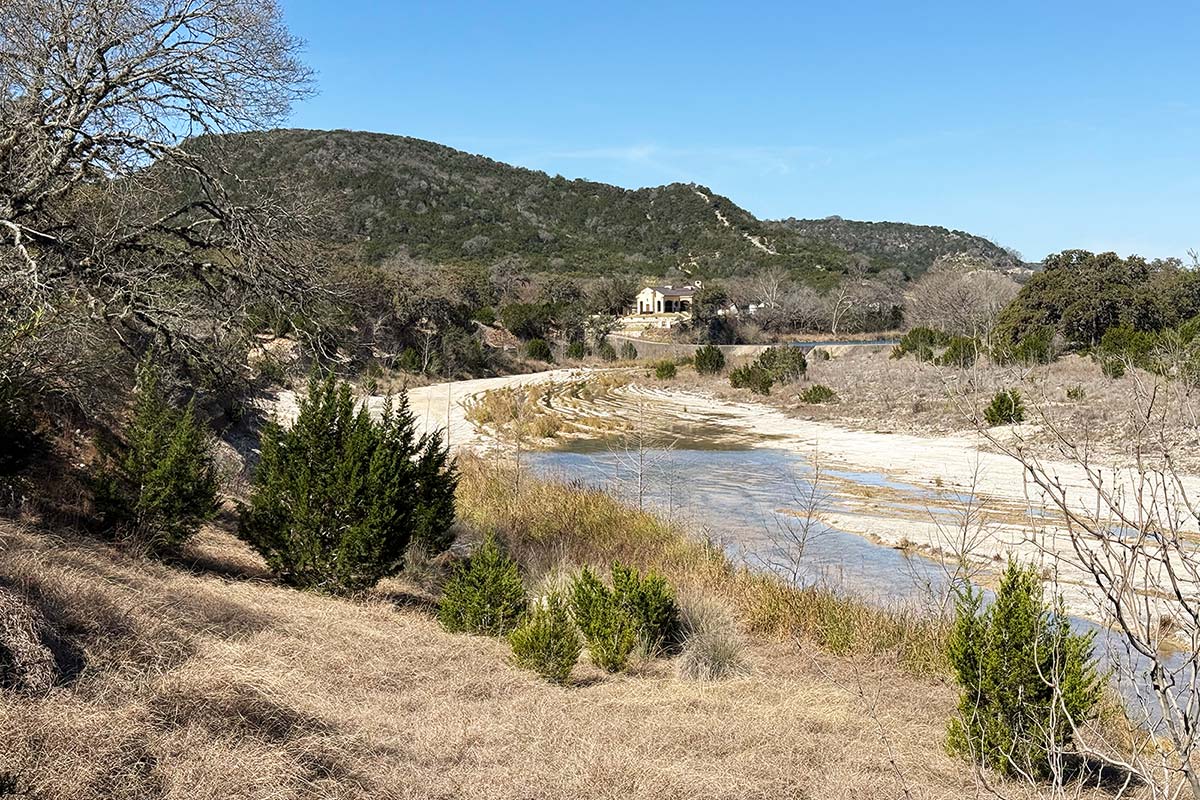
The west prong of the Medina River arises in Bandera County and flows eastward, fed by underground springs amid steep, canyon-carved terrain northwest of San Antonio. The flow traces a serpentine path through oak and cedar groves, rocky outcrops, and grassy slopes before joining the north prong near the town of Medina.
In 1915, this area was still a wild frontier—sparsely settled, with vast ranches dominating the landscape. The Medina Lake dam, completed in 1912, altered downstream flows, but the upper prongs retained their pristine character: clear waters, rocky riverbeds, and dense cedar and live oak groves.
It was beautiful country. I know this because Julian Onderdonk stopped here in 1915, set up an easel and canvas, and got to painting—and I can prove it.
It all started with a chance discovery: a digital image of an Onderdonk oil painting called Gulf Clouds in the Hills on the West Prong of the Medina River instantly caught my eye—not just for its beauty but for its uncanny resemblance to our land.
“Debra,” I called out to my wife, “you won’t believe it, but this is our property.”
I had just hiked those ridges that morning, stood on that same bluff and looked down at that same striated rock in the riverbed. The landscape in the painting wasn’t just similar—it was ours.
What started as a curious observation turned into a historical investigation—one that led me through Texas archives, family lore and conversations with art experts, historians and ranchers. The deeper I dug, the more the story grew. Not just one painting but possibly four were painted by Onderdonk during a 1915 visit to what was then known as the Williams Ranch, now part of our West Prong Ranch.
We acquired the property in January 2024—one of seven tracts carved from the historic Garrison Ranch, originally established in the late 1800s. Like many historic properties, the ranch evolved over time—its boundaries reshaped by sales, inheritances and a legal dispute—but the same beauty remains.
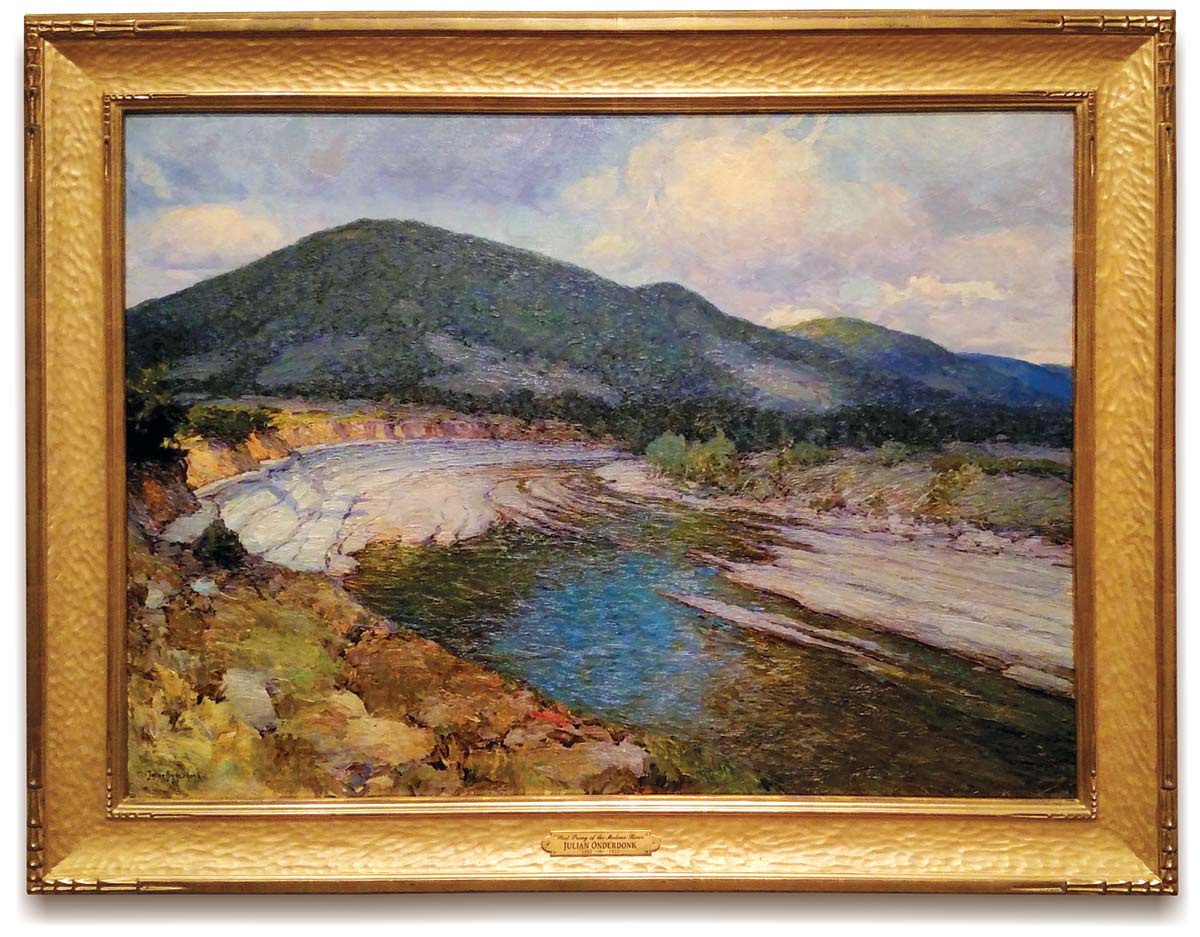
Gulf Clouds in the Hills on the West Prong of the Medina River, 1915, Oil on panel, Lusher Art Collection. This painting demonstrates the complex geographic identity of San Antonio’s countryside. The title and fluffy white clouds indicate the region’s proximity to the Gulf Coast. Green hills, characteristic of Central and South Texas, form the horizon. The west prong, illustrated here, is one of two main sections of the Medina River. The nearly dry river exposes the limestone bed, and there is just enough water to reflect the blue sky.
COURTESY LUSHER ART COLLECTION
The Man With the Brush
Often called the “Father of Texas Art,” Onderdonk left an indelible mark on American impressionism with his radiant Hill Country portrayals. Born in San Antonio in 1882, he trained under his father, artist Robert Jenkins Onderdonk, and later under William Merritt Chase in New York, honing his eye for light and texture.
Returning to Texas in 1909, Onderdonk fused Chase’s plein air, or open air, philosophy of painting outdoors with the rugged splendor of his homeland.
Onderdonk’s works—vibrant with color, delicately executed and alive with natural beauty—earned acclaim during his lifetime and reverence after his death in 1922.
Today his paintings command high prices: Blue Bonnet Field, Early Morning, San Antonio Texas sold for $515,000 in 2013. Two other pieces sold for $317,000 and $281,000 at that same auction in Dallas. His works have been on display in all of Texas’ major art museums, and several paintings even hung in the Oval Office when George W. Bush was president.
Each of the four 1915 paintings features terrain elements that resemble areas on or near our property—with live oaks, horizon lines and familiar contours we can still observe today. While there’s no direct evidence or documentation of such an excursion, the visual similarities raise the possibility they were painted during a multiday journey by mule into this remote region.
I hiked back out to the bend in the river and took a photo. From that vantage point, the similarities were undeniable. The limestone bluffs, the curve of the hills, the river’s arc and the distinctive limestone formations in the riverbed all aligned with striking precision—like fingerprints.
It was a match. Onderdonk’s Gulf Clouds in the Hills on the West Prong of the Medina River portrays the very terrain we now call home—capturing its distinctive topography with remarkable accuracy.
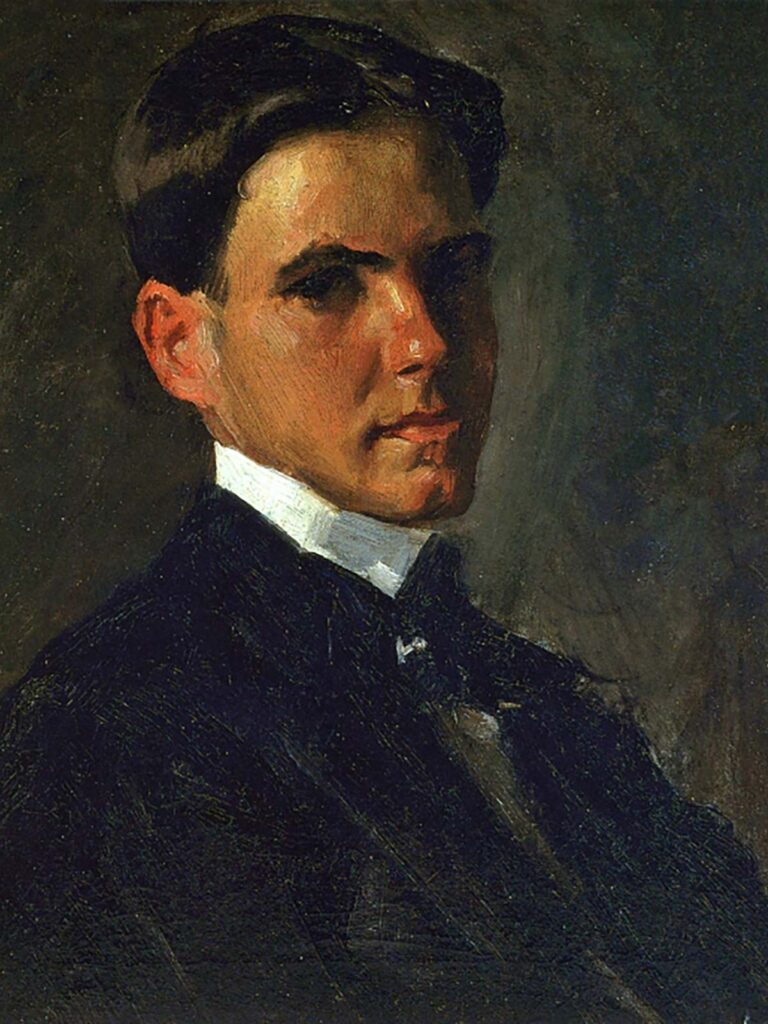
A 1901 portrait of Onderdonk, one of Texas’ artistic masters, by William Merritt Chase.
William Merritt Chase
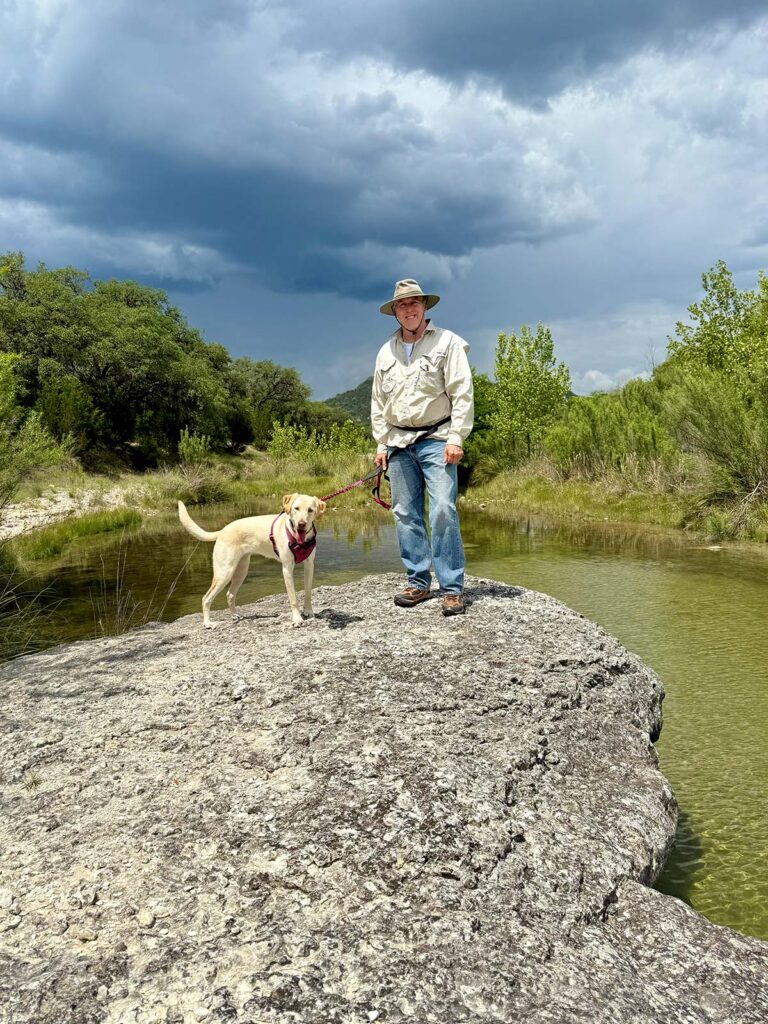
Millard stands with Daisy Jane on the property he bought with his wife in 2024. He considers their ranch a living gallery.
Courtesy Debra Millard
Collector of the Clouds
But for this discovery to be taken seriously, it needed more than compelling visual similarities; it needed validation from people who know Onderdonk best.
Art dealer Harry Halff is the foremost authority on Onderdonk and author of the artist’s catalogue raisonné—the definitive scholarly resource documenting the artist’s body of work.
“There is no doubt in my mind that the painting’s location is on your ranch,” Halff wrote in an email after reviewing the photographic comparisons and supporting documentation. “This may be one of the rare Onderdonk landscapes still visually tied to a named site today.”
Ted Lusher agreed with that assessment. He’s a respected collector of Texas art and history whose personal archive includes rare artifacts of Texas and Onderdonk’s original Gulf Clouds in the Hills itself.
“There’s no question in my mind,” he wrote of the similarities to our land. “The alignment of terrain and artistic detail is too precise to be coincidental.”
In 1915, traveling from San Antonio to Bandera County—about 50 miles away to the northwest—was challenging. With FM 337 not established until 1945, Onderdonk would have traveled over steep dirt trails and caliche paths, common in rural Texas at the time.
Automobiles like the Ford Model T had existed since 1908 but were impractical in the Hill Country’s rough conditions, especially for an artist of modest means. Instead, Onderdonk likely used horse-drawn transport, such as wagons or buggies for flatter areas, and possibly mules for the steeper terrain.
Halff notes that Onderdonk was “not averse to long hikes in the country,” often walking out into the hills armed with his easel, canvas and paints.
While Halff has not found any direct references to mule travel, he considers it “entirely plausible” that Onderdonk may have ridden by mule into more remote terrain.
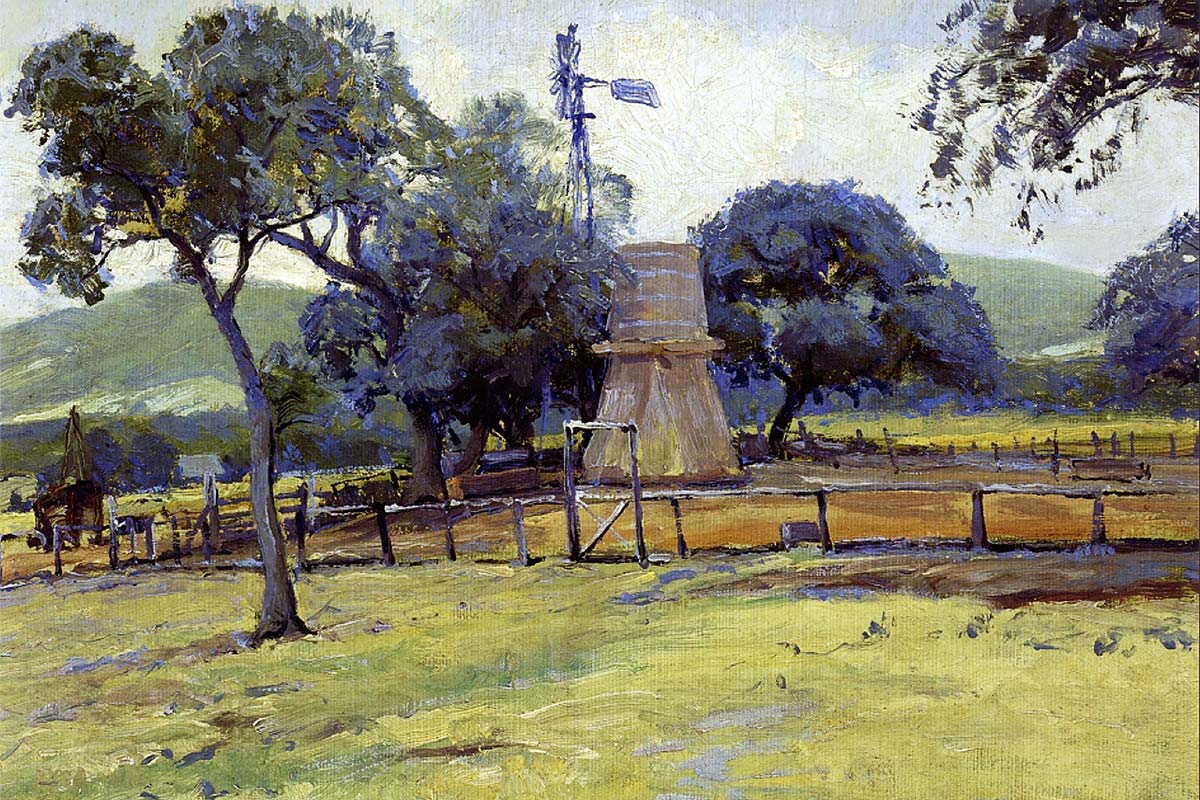
Millard’s research into Onderdonk suggests Windmill on Williams Ranch was also painted on his property in 1915.
Courtesy Lusher Art Collection
The Muleman Next Door
That brings us to Paul Garrison III, our neighbor and a skilled mule skinner.
Garrison’s family has lived and ranched on this land for five generations, and he carries forward the family legacy as the owner of Garrison Mulemanship and Training, a program known far and wide for cultivating the unique partnership between mules and their handlers.
Garrison and I discussed how Onderdonk might have reached this rugged, steep land more than a century ago. “There’s no way he got there by car,” he said. “You’d need
a good mule—maybe two. This is classic mule country.”
Before the Garrison family—and long before us—the land was known as the Williams Ranch. One of its earliest firsthand accounts comes from Samuel H. Sutton, who was born in 1850 and moved here in 1876.
One memory stood out for Sutton, writing for Frontier Times Magazine in 1928: He and his wife were washing clothes at the confluence of Cazey Creek and the west prong of the Medina River when they were surprised by Native Americans on a bluff above them. Sutton grabbed his rifle, his heart pounding. The moment passed without violence, but the tension and terrain left a mark on him.
His description of the bluff and the wash spot corresponds closely to the same curve and elevation where Gulf Clouds in the Hills was likely painted. It’s fascinating to think that within a few decades, this same bluff and river could have been the setting for a settler’s tense moment and an artist’s quiet observation.
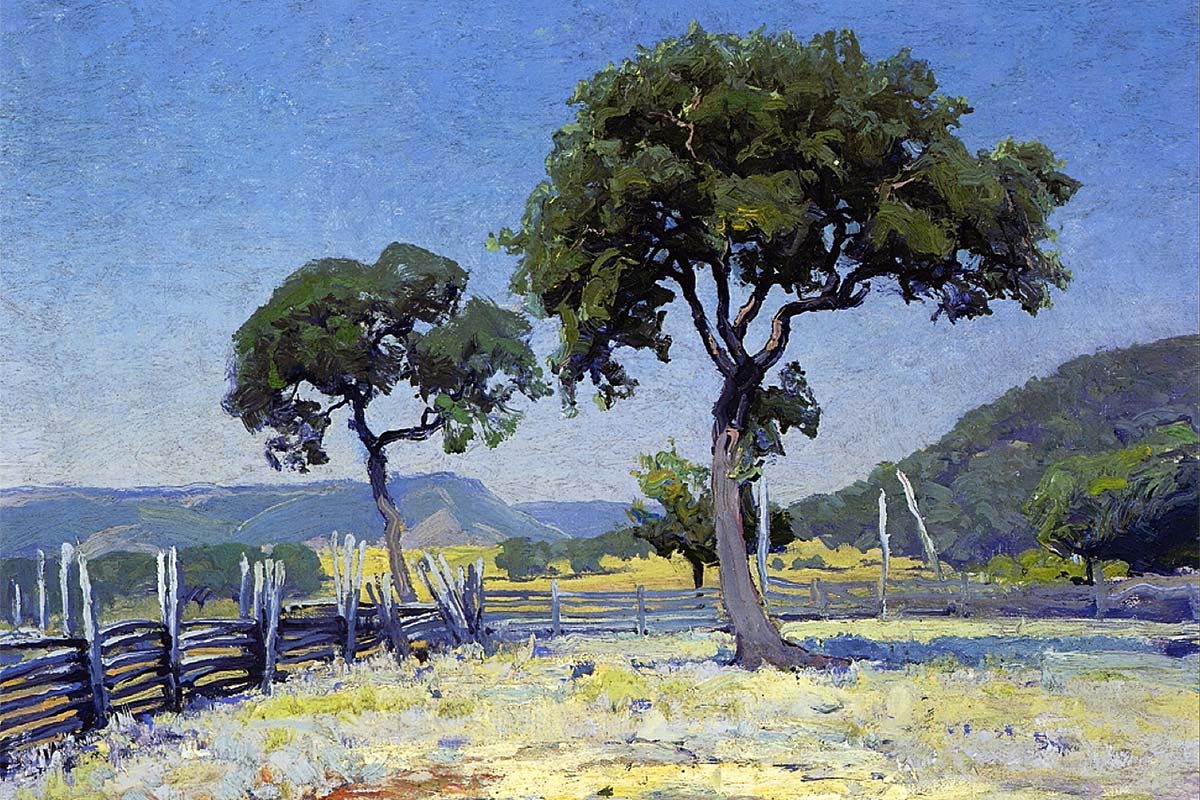
Live Oak Trees On Williams’ Ranch, Bandera County
Julian Onderdonk
Preserving the View
One of the most remarkable aspects of this story is how little the land has changed, and Debra and I are determined to keep it that way. We’ve intentionally avoided building in areas that would disrupt the natural setting and have left existing trails undisturbed.
For us, this land has become something rare—a kind of living time machine. The terrain remains so untouched, the features so distinctive, that the gap between today and 1915 seems to vanish.
Visitors notice it, too. When we show them the digital image of the painting beside the actual view, there’s often a long pause, followed by some variation of: “This place hasn’t changed at all.”
In a constantly evolving world, finding proof that a landscape has stayed so consistent is unusual. The land reflects the same beauty Onderdonk captured, and now, more than a century later, we can see it just as he did.
As landowners, we’re stewards of something much greater than ourselves. Our ranch is more than just acreage. It’s a living gallery—one that requires no velvet ropes, no security guards and no admission fee. Just boots, curiosity and a willingness to see.
We didn’t set out to uncover a hidden chapter in Texas art history. But once we realized what we were standing on, it became clear: This land belongs to history. To Onderdonk. To Sutton. To the Garrisons. And to everyone who’s ever paused to marvel at the way clouds move across the hills.
Gulf Clouds in the Hills isn’t just oil on canvas. It’s evidence. That Onderdonk stood here. That he saw what we see. And that he found it beautiful enough to preserve forever.
We’re honored to be part of that continuum.